I WOULD LIKE TO INTRODUCE YOU TO MY NEW WEBSITE...
Have a look! (it’s perrysaidman.com)

Analysis of and Commentary About Design Law Cases and Happenings
Have a look! (it’s perrysaidman.com)
Professor Peter Menell once again has come out swinging at design patents. But, like many of the great Muhammad Ali’s opponents, he’s gonna get knocked out.
The Professor organized a design patent conference about a year ago, hosted by the School of Law at the University of California, Berkeley, based on his thesis that design patent law has an “identity crises” that focused on the doctrine of design patent functionality. Peter invited the speakers, of which I was one, to submit papers that were recently published in Vol. 36 of the Berkeley Technology Law Journal in its issue called the “Design Patents Symposium”.
Apparently my paper “A Primer on Design Patent Functionality”, 36 Berkeley Tech. L.J. 147 (2021), did not make much of an impression on Peter. In his rebuttal “The Design Patent Emperor Wears No Clothes: Responding to Advocates of Design Patent Protection for Functionality”, 36 Berkeley Tech. L.J. (2021), he failed to respond to the most fundamental principle in my paper which was written as a primer so even a rookie boxer could understand it.
Of course, I am one of the “advocates” Peter is swinging at (and missing). The other advocate is the distinguished design lawyer Christopher Carani of McAndrews, Held & Malloy. Chris is an internationally recognized expert in the law of design patent functionality. His conference paper “All or Nothing at All: Design Patent’s Ornamentality Requirement and the Failings of Feature Filtration”, 36 Berkeley Tech. L.J. 213 (2021), addresses another of Peter’s misguided notions.
I feel compelled to go a few rounds with Peter to demonstrate his rookie boxing technique. This will be the first round, and a short one, lasting as long as it takes to review this blog, maybe a minute or two. I cannot cover all of his missteps in a single, short blog. There may be more rounds coming up as I slog through his article to address other of his design patent shibboleths, provided I get a satisfactory answer to the basic principle discussed below. In this first round, I will not have to resort to the Ali shuffle; I can stand immobile in the ring and Peter will still miss. The referee should simply declare a TKO and hold up my hand now, negating the need for further rounds and saving Peter a beating.
The basic principle that knocks down virtually all of Peter’s arguments is this: design patents do not protect how utilitarian/functional features or components work, only how they look, their appearance. I’ve never seen any response to this statement from the Professor, or anyone else.
It almost goes without saying that since a design patent protects only how a design looks, not how it works, there is no concern – none – that claimed designs are somehow monopolizing how functional/utilitarian features work. There is absolutely no basis for saying that the utility patent system is being usurped by the design patent system.
The statute that defines design patentable subject matter (35 U.S.C. 171) requires a design to be “for an article of manufacture”. These words also appear as a requirement for design patentability in the 1902 Patent Act (upon which Peter relies heavily in asserting design patents somehow monopolize functional/utilitarian features). An article of manufacture by definition includes functional/utilitarian features. If it was the case, as the good Professor asserts, that design patents that claim functional/utilitarian features do not qualify for design patent protection, there would be no design patents. Is this the goal of Prof. Menell? Probably.
But no modern court has ever said that a design patent is invalid if it simply illustrates, i.e., claims the appearance of, utilitarian components/features. It is the overall appearance of the claimed design, including all utilitarian/functional features, that defines the visually protected subject matter. Post Federal Circuit courts have recognized this simple, basic fact. It is not necessary to delve into the unsophisticated reasoning of ancient cases.
All utilitarian components/features have an appearance, a look. It is their appearance that matters in a design patent, not how they work. I agree with the good Professor that if an inventor wants to protect the function of how such components/features work, i.e., what they do, they must get a utility patent.
As repeatedly [repeat: repeatedly] emphasized in my paper, since a design patent does not protect how utilitarian/functional elements work, it is manifestly true that anyone is free to use the so-called functional/utilitarian elements disclosed in a design patent to perform their functions as long as their product doesn’t LOOK LIKE the overall appearance of the claimed design. The Lee v. Dayton Hudson case, discussed on pp. 154-155 of my paper, is an excellent example of this.
In conclusion, and I don’t know how many times I have to say this before it sinks in: DESIGN PATENTS DO NOT PROTECT THE FUNCTION OF ANY ELEMENTS THAT ARE PART OF THE DESIGN PATENT CLAIM. THEY ONLY PROTECT THE WAY THEY LOOK. ANYONE IS FREE TO USE UTILITARIAN ELEMENTS THAT ARE PART OF THE CLAIMED DESIGN IN THEIR OWN PRODUCTS THAT PERFORM EXACTLY THE SAME FUNCTION, AS LONG AS THEIR PRODUCTS DON’T LOOK LIKE THE OVERALL APPEARANCE OF THE PATENTED DESIGN. The good Professor has, throughout all of his writings, never addressed this basic issue, avoiding it like the plague, because (a) it’s true; and (b) it undercuts every single argument he makes.
In short, this bout should be over on a TKO, before even round two begins, stopped by the referee before Menell is seriously hurt. I need not even enter the ring to contest the rest of Peter’s screed, since I’ve already won. If he is unable to respond to my basic principle, and so far he has not, then the rest of his arguments get TKO’ed as did Joe Frazier in the Thrilla in Manila.
So I call on Peter to once and for all respond to that very simple and basic principle, namely, that a design patent does not protect the function of any of the functional/utilitarian features claimed as part of an overall design; it only protects the appearance of the entire claimed design. I’m honestly tired of saying this, but here goes: ANYONE IS FREE TO INCORPORATE IN THEIR OWN PRODUCT THE FUNCTION OF THE FUNCTIONAL/UTILITARIAN FEATURES SHOWN AS PART OF AN OVERALL CLAIMED DESIGN AS LONG AS THEIR PRODUCT DOES NOT LOOK LIKE IT.
The boxing world awaits. Meanwhile, I graciously accept my championship belt, until such time as the Professor gets up the nerve to challenge my basic principle, re-enters the ring, and actually connects with a swing.
In Season 1, Episode 1, the district court granted Columbia’s motion for summary judgment of infringement against Seirus based on Columbia’s design patent D657,093 for a Heat Reflective Material. A jury trial was then held on the issue of damages, and the jury awarded Seirus’ total profit to Columbia. Seirus appealed to the Federal Circuit. One of the issues facing the Court was determining the article of manufacture for calculating total profit damages, a critical question left open by the Supreme Court in Samsung v. Apple. The Federal Circuit did not rule on that important issue, instead finding that the presence of Seirus’ logo on its products should be considered in determining infringement.
In Season 1, Episode 2, a petition for rehearing was filed, supported by a number of amicus briefs, to try and get the Court to reconsider its position regarding the effect of Seirus’ logo. The petition was denied, whereupon the case was remanded to the district court for retrial.
Now we are proud to present in a brand new season (Season 2, Episode 1) of Columbia v. Seirus.
On remand from the Federal Circuit a jury found no infringement of Columbia’s design patent, basing its verdict in part of consideration of the following “comparison” prior art presented by Seirus (shown after the patented and accused designs):
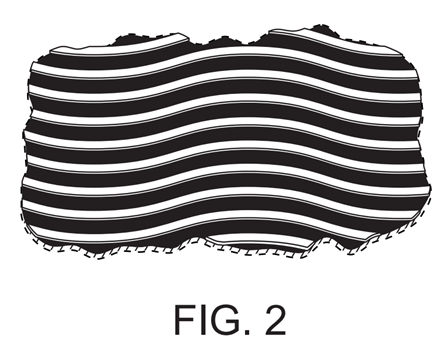
COLUMBIA’S PATENTED DESIGN

SEIRUS ACCUSED DESIGN

Prior Art #1: METHOD OF PROVIDING PLASTIC SHEETS WITH INLAID STRIPES

Prior Art #2: BREATHABLE SHELL FOR OUTERWEAR

Prior Art #3: UNWOVEN PRODUCT AND PROCESS FOR MAKING THE SAME
Columbia has appealed to the Federal Circuit.
There are 2 main issues on appeal.
1. The jury’s consideration of prior art designs that were not the same as, or analogous to, the article of manufacture as the patented and accused designs; and
2. The jury’s consideration of Seirus’ logo in determining infringement.
Issue #1 involves the Federal Circuit’s recent opinion In re Surgisil which reversed an examiner’s anticipation rejection since the prior art reference to an art tool – despite looking almost identical to the claimed design - was not the same article of manufacture – a lip implant - as the claimed design. See my prior post.
Issue #2 challenges the Federal Circuit’s prior decision in Season 1, Episode 1. This is a critical issue since the prior decision opened the door for infringers to avoid infringement simply by putting its name/logo on its products. It will be interesting to see if Columbia’s argument changes the Court’s position.
More specifically, Columbia framed the following issues facing the Court in its opening brief:
1. As a matter of first impression for the Court, and in view of this Court’s recent decision in In re Surgisil, L.L.P., 14 F.4th 1380, 1382 (Oct. 4, 2021), what is the relevant scope of “comparison prior art” that is to be considered in a design patent infringement analysis under Egyptian Goddess, Inc. v. Swisa, Inc., 543 F.3d 665, 678-79 (Fed. Cir. 2008) (en banc)?
2. Whether the district court erred in instructing the jury that all prior patents are comparison prior art to a design patent, and in failing to instruct the jury to limit the scope of comparison prior art for the design infringement analysis to “heat reflective materials,” which is the article of manufacture identified in the claim of the asserted U.S. Patent D657,093 (D’093 Patent)?
3. Whether, in the alternative, the district court erred in failing to instruct that “the scope of prior art” to a design patent is limited to “designs of the same article of manufacture or of articles so similar that a person of ordinary skill would look to such articles for their designs,” as this Court held in Hupp v. Siroflex of Am., Inc., 122 F.3d 1456, 1462 (Fed. Cir. 1997).
4. Whether the district court erred in prohibiting Columbia from distinguishing prior art on grounds that it failed to disclose a “heat reflective material,” which is the article of manufacture identified in the claim of D’093 Patent?
5. Where the Gorham standard applicable to design patent infringement concerns “deceiving” a consumer concerning products available for “purchase,” and where (a) Columbia did not sell a patented product for purchase, and where (b) Seirus applied its brand name to its products, whether the district court erred in failing to instruct the jury that:
a. “Likelihood of confusion,” or “confusion as to the source or provider of the goods accused of infringing is irrelevant to determining whether a patent is infringed,” as this Court held in Braun Inc. v. Dynamics Corp. of Am., 975 F.2d 815, 820 (Fed. Cir. 1992), and Unette Corp. v. Unit Pack Co. Inc., 785 F.2d 1026, 1029 (Fed. Cir. 1986); and
b. “Labelling a product with source identification or branding does not avoid infringement,” as this Court held in L.A. Gear, Inc. v. Thom McAn Shoe Co., 988 F.2d 1117, 1126 (Fed. Cir. 1993).
STAY TUNED for our next exciting episode, where the big reveal will be Seirus’ opening brief.
In re: Surgisil was decided by the Federal Circuit on October 4, 2021. It clarified the scope of protection afforded to a design patent.
The design is for a lip implant. The claim is “The ornamental design of a lip implant as shown and described”. It was rejected by the examiner under Sec. 102 as anticipated by a Blick art tool called a “stump” used for smoothing and blending large areas of pastel or charcoal. The claimed lip implant and 102 reference are shown below:

Patented design: Lip Implant

102 Reference: Art Tool
The applicant appealed to the Board, arguing that Blick could not anticipate because it disclosed a “very different” article of manufacture than a lip implant. The Board affirmed the examiner’s anticipation rejection, saying “it was appropriate to ignore the identification of the article of manufacture in the claim language” and “whether a reference is analogous art is irrelevant to whether that reference anticipates.”
The Federal Circuit reversed the rejection. It noted that Sec. 171 of the Patent Act permitted the grant of a design patent only to “a design for an article of manufacture”, and since the claim was limited to a lip implant, an art tool cannot be an anticipatory reference. The scope of the claim was therefore narrowed to lip implants.
This decision is consistent with the Court’s earlier decision of Curver Luxembourg v. Home Expressions where the design claim was a pattern for a chair, and the accused design – although using the same pattern – was a basket. The designs in that case are shown below.

Patented Design: Pattern for a Chair

Accused design: Basket
The Court easily concluded that a basket is not a chair, therefore no infringement.
What are the implications of Surgisil? First, design patent applicants need to choose their title/claim very carefully, since it will clearly have a direct effect on the scope of protection of their design. We may see applicants filing different design patent claims such as “The ornamental design of a gizmo, widget and/or thingamajig, as shown and described” where the applicant wants to cover more than one article of manufacture. An alternative strategy may be to file multiple design applications claiming the same design on different articles of manufacture. Infringers – ever clever – might appropriate a patented design for a totally different product, and thus fall outside the scope of the claim. And theoretically it might be possible to obtain a patent on a design that is in the public domain on one article, but that claims it on a different article.
This case is in sharp contrast the European system where a registered design covers the design per se without regard to an article of manufacture. In other words, the basket maker who copied Curver’s chair pattern would not escape liability under the European system.
Keep in mind that 35 U.S.C. 171, which defines statutory subject matter for design patents, says: “Whoever invents any new, original and ornamental design for an article of manufacture may obtain a patent therefor…” The requirement that a design be “original” is the subject of very little case law. But originality might come into play when considering the situation where someone copies a public domain design on a widget and applies it to a gizmo. In such a case, is the design of the gizmo truly “original”?
It also raises the larger question of whether the “article of manufacture” requirement ought to be excised from the statute, to bring the US design protection system into harmony with the European system, and to dispense with all of the litigation surrounding “article of manufacture”. For example, it would eliminate the laughable requirement that in an application for a GUI design the applicant must illustrate a broken line “screen” around the GUI, the screen being the “article of manufacture”. More importantly, it would mitigate the Supreme Court’s terrible decision in Samsung v. Apple where it held that “article of manufacture” under Sec. 289 (for the purpose of calculating total profit damages) could be either the end product as sold, or a component of the end product. This has created scads of litigation, when logically an infringer ought to be liable for its total profit on the end product as sold, since that’s the reason they copied the design.
On September 20, 2021, Gamon filed a petition for en banc review of the decision of the Federal Circuit of August 19, 2021 in which the Court reversed the PTAB’s finding that had held that Gamon’s two (very similar) design patents were nonobvious in view of the extensive evidence of copying by Campbell.
My blog last month reviewed the Federal Circuit’s decision. Just so you know where I stand, the column was titled: IN A BREATHTAKING OPINION, THE FEDERAL CIRCUIT NIXES NEXUS FOR DESIGN PATENTS, EQUATES THEM WITH UTILITY PATENTS, AND IGNORES STRONG EVIDENCE OF COPYING
There are three major points worthy of en banc review.
First, the law of the presumption of nexus was basically jettisoned. The Court had said that any additional structure outside the elements that make up the claim of a patent makes a finding of co-extensiveness, and consequently a presumption of nexus, impossible.
Second, the Court reversed the PTAB finding of nexus-in-fact based on “unique characteristics” of the designs, which they seemed to translate into a point of novelty test. The court said one claimed element (out of three) was in the prior art, thus there was no nexus.
Finally, and perhaps most egregiously, the Court’s assessment of the record ignored the evidence of copying, which goes against case law that said copying is prima facie proof of nexus. This is particularly important in design patent law, since virtually all cases involve copying by the infringer.
It is worth reviewing the issue of copying. Evidence of copying was strong, fully briefed, and relied upon by the Board. The Board said:
“The final trial record before us is replete with evidence of copying.
[C]opying requires evidence of efforts to replicate a specific product, which may be demonstrated through internal company documents, direct evidence such as disassembling a patented prototype, photographing its features, and using the photograph as a blueprint to build a replica, or access to the patented product combined with substantial similarity to the patented product.
Campbell’s internal presentations in 2002 demonstrate that Campbell was aware that Gamon’s gravity feed display racks would increase sales volume of Campbell’s soup. After obtaining the results of the Cannondale survey, Campbell purchased tens of thousands of Gamon’s display racks between 2002 and 2009. Campbell had access to the patented design and significant motivation to continue using the same design. Campbell’s annual reports praise the Gamon display racks and link increased Campbell soup sales to the ornamental features of these display racks. See supra. Around 2009, Campbell transitioned from purchasing Gamon’s display racks to those sold by Petitioner Trinity. The Trinity display racks are substantially similar to the Gamon racks, especially as related to the patented ornamental front label area and the ability to place a cylindrical object below the label area.
Campbell’s and Trinity’s access to the patented product combined with substantial similarity of Trinity’s product to the patented product provide unrefuted evidence that Gamon’s display racks were copied. Petitioner has not presented any evidence to refute copying. To the contrary, Petitioner admitted that their only rebuttal to Gamon’s copying allegations was that the patents should be held invalid or that there was no pending patent claim when the Gamon products were copied.
Accordingly, we determine that Gamon has established that Petitioner copied Gamon’s patented display racks.”
Here's the sum total of what the Federal Circuit said about copying:
“For purposes of this appeal, we assume substantial evidence supports the Board’s finding that Trinity copied the unique characteristics of the claimed designs. Even accepting the evidence of copying, we conclude that this alone does not overcome the strong evidence of obviousness that [the prior art patent to] Linz provides.”
The chance of the Court granting a petition for en banc review is quite small, so the next stop for Gamon may be a petition for cert. to the U.S. Supreme Court.
The Court of Appeals for the Federal Circuit in Campbell Soup Company v. Gamon Plus (August 19, 2021), speaking through Chief Judge Moore, once again exhibited its misunderstanding of design patents compared to utility patents.
The Court reversed two decisions of the Patent Trial and Appeal Board that had held two of Gamon’s design patents, D612,646 and D621,645, nonobvious in view of extensive and persuasive evidence of commercial success and copying (see my prior blog). Such evidence is referred to as “secondary considerations” even though it is considered alongside evidence regarding the claimed design and the prior art. In other words, even if the claimed design is deemed obvious in view of the prior art, a strong showing of secondary considerations can render the design patentable. As famously stated by the Federal Circuit in Apple v. Samsung:
“Indeed, evidence of secondary considerations may often be the most probative and cogent evidence in the record. It may often establish that an invention appearing to have been obvious in light of the prior art was not. It is to be considered as part of all the evidence, not just when the decision maker remains in doubt after reviewing the art.”
Here is a snippet of the extensive secondary considerations in this case (far more details are in the Board’s decisions). Campbell Soup, Gamon’s customer, had bought $31 million of Gamon’s IQ Maximizer, a gravity feed dispenser for soup cans. Campbell placed them in 2,800 stores, and touted the design to investors in its 2005 Annual Report: “[t]he strong performance of Campbell’s condensed soup business demonstrates the value of the IQ Maximizer, an innovative gravity-feed shelf system for merchandising soup…. making the soup aisle dramatically easier for consumers to shop.” Campbell’s 2006 Annual Report described the IQ Maximizer as now “available in 16,000 stores… [it] continues to be a powerful tool to merchandize Campbell’s condensed soups.” Campbell described the IQ Maximizer as a “tool to deliver impactful consumer messages at the point of purchase …. [and is] a breakthrough in soup merchandising.” Later Campbell began purchasing gravity feed display racks from another company, Trinity, the manufacturer of the infringing racks, that “maintained the same ornamental design features as the Gamon racks.”
The two design patents - very similar in scope - claimed portions of Gamon’s gravity feed dispenser. In the ‘646 design patent, the portions claimed were the front-facing label display area, a cylindrical can, and vertical tabs or stops, as shown in solid lines in the sole figure of the ‘646 patent (the ‘645 patent did not claim the tabs):

GAMON’S PATENTED DESIGN
As seen above, there are extensive broken lines that outlined disclaimed portions of the dispensers, mainly the side portions. Significantly, and ignored by the Court, these unclaimed portions could not be seen by an ordinary observer when the dispensers were on a shelf of a supermarket lined up side-by-side and thus had no ornamental impact on sales of the IQ Maximizer or soup cans. As shown in the link below, only the claimed front portions are visible to a purchaser.
Thus, the unclaimed hidden portions were manifestly insignificant to the ornamental appearance of Gamon’s commercial product. They were not only unimportant, but were not touted by Campbell in its numerous accolades of the commercial product. Gamon didn’t claim them because no one cared what they looked like, and moreover it would be too easy for a competitor to redesign those hidden portions. Indeed, that’s exactly what Trinity/Campbell did. But they didn’t redesign the claimed elements; they copied them. Campbell did not dispute this.
The primary reference applied against the claims was the Linz patent:

As is plain as day, the Linz patent lacks a primary claimed feature: the cylindrical can. Nevertheless, in an earlier opinion, the Court presumed the presence of a can in Linz (see another earlier blog) This was clearly a distortion of the law of non-obviousness, as set forth in Judge Newman’s cogent dissent.
But I digress. In the present case, the Board of course felt obligated to follow the Court’s misbegotten logic in its earlier opinion and found the claimed design obvious over Linz. As noted above, Gamon presented compelling evidence of secondary considerations; namely, commercial success and copying. It was so overwhelming that the Board found the two design patents nonobvious, even in view of Linz. This appeal followed.
Evidence of secondary considerations must have a “nexus” to the commercial product, i.e., the IQ Maximizer. That is, there must be “a legally and factually sufficient connection between the evidence and the patented invention”.
Nexus can be found to be “presumed”, or “in fact”. The Court addressed these issues separately.
a. presumed nexus
Relying on Fox Factory, Inc. v. Sram, LLC, the Court said: “As first recognized in Demaco Corp. v. F. Von Langsdorff Licensing Ltd., a presumption of nexus exists between the asserted evidence of secondary considerations and a patent claim if the patentee shows that the asserted evidence is tied to a specific product and that the product is the invention disclosed and claimed (emphasis in original). Conversely, [w]hen the thing that is commercially successful is not coextensive with the patented invention – for example, if the patented invention is only a component of a commercially successful machine or process,” the patentee is not entitled to a presumption of nexus, citing Demaco.
But the latter quote from Demaco was dicta, since the claimed invention in that utility patent case was a unitary paver stone, not a component of a machine or process. Design patents were not at issue.
Moreover, the Demaco court gave an example from the utility patent case Hughes Tool v. Dresser that held that “such continuous use of the patented feature while other features were not copied gives rise to an inference that there is a nexus between the patented feature and the commercial success.” In Gamon, the unclaimed side portions were not copied, only the front-facing portions of the label area, the can, and the tabs. So Demaco seems to support Gamon.
Also, the Demaco court relied on Railroad Dynamics, Inc. v. A. Stucki Co. that said: “The testimony as to the advantage of the spaced structure with the biasing spring easily supports the inference that the claimed invention itself was responsible for the commercial success”, a statement that if anything supports Gamon.
Thus, the Court’s reliance on Fox Factory was at best shaky.
b. nexus-in-fact
The Court stated that: “A patentee may establish nexus absent the presumption by showing that the objective indicia [of secondary considerations] are the ‘direct result of the unique characteristics of the claimed invention”, citing in support In re Huang and Ormco Corp. v. Align Technology, Inc.
The Court interpreted the unique characteristics to mean the features that distinguish the claimed design from the prior art.
The Court’s decision regarding nexus-in-fact rested on its finding that the label element – what they deemed to be the only factor in the evidence of commercial success – was in Linz, the prior art. But the other two elements were absent: the can, and the vertical rectangular tabs (Linz’s tabs are rounded). The Court thus deconstructed the claimed design by ignoring the other two elements.
Indeed, what are the unique characteristics of Gamon’s claimed design? The answer is, of course, the features that were patented – the combination of the label area, the can, and the tabs. However, the Court focused only on the label area rather than the claimed combination.
Moreover, Huang actually said: “[commercial] success is relevant in the obviousness context only if there is proof that the sales were a direct result of the unique characteristics of the claimed invention – as opposed to other economic and commercial factors unrelated to the quality of the patented subject matter”. In Gamon, there was no evidence of “other economic and commercial factors”, so Huang is not on point.
In Ormco, the Court said “[I]f the commercial success is due to an unclaimed feature of the device, the commercial success is irrelevant.” In Gamon, it can hardly be argued that the appearance of the unclaimed features resulted in the commercial success. There was no showing that the appearance of the unclaimed side portions of the IQ Maximizer had any impact on commercial success; in fact, it was just the opposite. It was the front facing portions, i.e., the label area, the can and the tabs that consumers saw and caused them to gravitate towards the product.
The Court found Gamon’s commercial success evidence was not directed to the can or the tabs; only the label area, finding that the latter was in the prior art to Linz. However, the Board, in its extensive review of this evidence, had concluded that: “The final record establishes persuasively that the claimed ornamental design features, specifically the pronounced label area resembling the side of a can, as well as the cylindrical can lying on its side underneath the label area, attracted customers to the gravity feed display and allowed them to efficiently find and purchase soup products.” The Board also cited the testimony of the inventor Terry Johnson, who explained that putting the can on its side was important and “what the consumer saw because there was a big convex sign that was the same as the label and it was in the same proportions as the can.” The Board had concluded: “The evidence shows that this proportionality in the claimed design was original and created a display that looked like a soup can, which contributed to the success of the patented display rack and also to increased soup can sales.” The Court dismissed Johnson’s testimony as “self-serving”, but cited no evidence to the contrary.
In response to Gamon’s evidence that the label area displays soup labels printed twice their normal size, the Court said that “the claimed designs do not require any specific size of the label area…because the patents’ figures depict the label area boundaries using broken lines… the size of the label area is not claimed.” Clearly, even though the boundaries themselves are disclaimed, all of the surface area between the boundaries is claimed (yet another example of the Court’s fundamental misunderstanding of design patents). Thus, the size of the label area, and the fact that it’s about twice the size of the soup label, is readily discernable.
c. Copying
In the Court’s penultimate paragraph, it chose to ignore copying of the patented design by Trinity, saying:
“[W]e assume substantial evidence supports the Board’s finding that Trinity copied the unique characteristics of the claimed designs. Even accepting the evidence of copying, we conclude that this alone does not overcome the strong evidence of obviousness that Linz provides.”
This is astonishing. There’s no reason that evidence of commercial success trumps evidence of copying. The Court gave none. Instead, it dismisses evidence of this particular secondary consideration in favor of its finding that Linz rendered the claimed designs obvious. How can it do this when copying can be “the most probative and cogent evidence in the record”? (see Apple v. Samsung).
d. The Design Patent/Utility Patent Morass
Inexplicably, the Federal Circuit dismissed the differences between design patents and utility patents, saying:
“[T]he coexensiveness requirement [of the presumption of nexus] does not depend on the type of patent at issue. The Board offered no rationale for taking a different approach in design patent cases, and we do not discern any. Accordingly, we reject the proposition that a product satisfies the coextensiveness requirement in the design patent context merely if its unclaimed features are ornamentally insignificant.” (emphasis in original).
The Court veered off the rails here.
It hardly need be pointed out the differences between a design patent and utility patent. A design patent claims the appearance (ornamental) features of a product, while a utility patent claims functional features. In the context of the nexus requirement, it only makes sense that there must be a connection between the evidence of secondary considerations and the appearance features of a claimed design rather than functional features. In other words, unclaimed functional features should not matter in analyzing nexus for a design patent. This is why the Court erred in saying:
“In determining coextensiveness, the question is not whether unclaimed features [of Gamon] are insignificant to a product’s ornamental design. The question is instead whether unclaimed features are “insignificant,” period.” (emphasis in original). It relied again on Fox Factory (a utility patent case in which the unclaimed features are indeed functional).
The Court then made the following, totally illogical statement:
“Because the IQ Maximizer undisputedly includes significant unclaimed functional elements, no reasonable trier of fact could find that the IQ Maximizer is coextensive with the claimed designs.” (emphasis added). The Court’s reliance on unclaimed functional features is clear error.
Moreover, as noted above, the unclaimed features in Gamon’s IQ Maximizer, being the sides of the dispensers - are not visible in normal use, which attests to their lack of ornamental qualities and importance.
Perhaps most disturbing was the Court’s sole footnote in which it said “We do not go so far as to hold that the presumption of nexus can never apply in design patent cases. It is, however, hard to envision a commercial product that lacks any significant functional features such that it could be coextensive with a design patent claim.” (emphasis added). This statement, even though dicta, places most, if not all, design patents at a great disadvantage in obtaining preliminary injunctions, where a showing of nexus is a necessary requirement. This is because most design patents today are for partial designs, i.e., claim only a portion of a product. Design patent practitioners routinely disclaim portions of a design that are deemed insignificant, in the prior art, or easy to design around.
Further, the Fox Factory utility patent case relied on by the Court said that “A patent claim is not coextensive with a product that includes a ‘critical’ unclaimed feature … that materially impacts the product’s functionality…” (emphasis added). Again, unclaimed functional features are of no moment in a design patent, and thus can never be deemed “critical”.
The only elements critical to the product’s ornamental appearance were the front-facing portions, i.e., the label area, the can, and the tabs.
An en banc petition is likely in the offing.
In Range of Motion Products, LLC v. The Armaid Company Inc., a district court in Maine on August 6, 2021 denied plaintiff’s motion for a preliminary injunction based largely on the alleged failure of plaintiff to show a likelihood of success on the merits. This was based on the court’s flawed analysis of claim construction and infringement.
The district court in its claim construction relied heavily upon Sport Dimension v. Coleman in separating so-called functional features from ornamental features. It said:
“… the task at this stage of the analysis is to identify the features of the claimed design that are ornamental (and therefore part of the protected design) and those that are functional (and therefore not protected).”
Slip op. at 12.
However, Sport Dimension did not say that. The Federal Circuit, in its extensive review of its prior decisions, did say:
“In OddzOn, Richardson, and Ethicon, we construed design patent claims so as to assist a finder of fact in distinguishing between functional and ornamental features. But in no case did we entirely eliminate a structural element from the claimed ornamental design, even though that element also served a functional purpose.”
The district court in Range did exactly the opposite. It identified the so-called functional elements and eliminated them from the claim construction. The court then performed the super-gymnastic feat (it would have won a gold medal in the new Olympic event: Convoluted Claim Construction) of comparing what was left – the ornamental elements – to the accused design – in determining infringement. In so doing, it managed to discount the most probative factor of non-functionality – the existence of alternative designs – by saying (in another medal-worthy analysis) that the alternative presented by the patentee differed in functional aspects.
In its analysis of infringement, the court relied on the highly-flawed Lanard case from the Federal Circuit (see my previous blog), again concluding that the “common basic shape [of the patented and accused designs] is driven by purely functional considerations.”
Rather than dig into the minutiae of the court’s analysis, it would be more helpful, I think, to remind readers of the Federal Circuit’s well-accepted claim construction functionality analysis from Sport Dimension. The following excerpts should suffice:
“[E]ven though we agree that certain elements of Coleman’s design serve a useful purpose, we reject the district court’s ultimate claim construction. The district court eliminated the armbands and side torso tapering from the claim entirely, so its construction runs contrary to our law. Here, as in Ethicon, “the district court’s construction of the Design Patents to have no scope whatsoever fails to account for the particular ornamentation of the claimed design and departs from our established legal framework for interpreting design patent claims.” Ethicon Endo-Surgery, 796 F.3d at 1334.”
“Although the design patents do not protect … general design concepts of utilitarian elements… they nevertheless protect the particular appearance of the elements.”
In summary: all claimed elements, whether utilitarian or not, must be taken into account in determining infringement,
Said another way: since all claimed functional elements have an associated appearance, such appearance is part and parcel of the claimed design.
As I said at the Berkeley conference (BCLT Symposium on Functionality) earlier this year, you can’t ignore utilitarian features simply because they perform some function. Indeed, all elements of a vast majority of designs perform some sort of function, and if they were to be eliminated there would be nothing left to analyze.
This is so basic that any court decision – such as Range – that does otherwise commits clear error.
Join me for an upcoming Strafford live webinar, "Design Patent Litigation: Increasing the Probability of Success" on Thursday, September 9, 1:00pm-2:30pm EDT. Click this link for more information: https://www.sp-04.com/r.php?products/txhpggekna
On the lighter side, here’s a fun story about design patents, my son, and the Night Stalker…
In a well-reasoned opinion, Larry G. Junker v. Medical Components, Inc. et al. (No. 13-4606) (January 14, 2021), Judge Goldberg of the United States District Court for the Eastern District of Pennsylvania decided after a bench trial that Plaintiff’s U.S. Pat. No. D450,839 for a “Handle for Introducer Sheath” is valid and infringed.
Although the opinion covered a number of issues (inventorship, anticipation, obviousness), I found it most notable for the Court’s infringement analysis that concluded that certain portions of the claimed design “predominate” over other portions in the eye of an ordinary observer. Also of interest was the Court’s application of the 4-factor test for determining “total profit” damages under 35 U.S.C. 289.
Representative Figures 1 and 7 illustrate perspective and bottom views of the patented design:

FIG. 1 Junker USPN D450,839

FIG. 7 Junker USPN D450,839
Regarding infringement, the Plaintiff argued that “the primary ornamental feature” is the “enlarged rounded ears” which are present in all of the accused products. Plaintiff also argued that the enlarged, rounded, upswept ears stand out as a “total departure” from the prior art, and that the accused products are much closer to the claimed design than the prior art.
Defendants countered that the ordinary observer would not be induced to purchase the accused products by the design of the handle but would likely notice differences in designs no matter how small. Among other things, the Defendants pointed to the following differences:
*the ‘839 patent claims a conical tapered cone that blends with a fillet into the tabs on the sides of the handles, while the Defendants’ products utilize “two cylinders of different diameters stacked upon each other” rather than a tapered cone.
*Fig. 6 illustrates a swept-back, curved wing not present in the accused products.
*the ‘839 patent contains different numbers of ribs on the wings
The Court gave great weight to Plaintiff’s expert, Peter Bressler, who said that the ears or tabs of the accused products would receive an ordinary observer’s “primary level of attention” when viewing the whole product. Although Bressler also said that the ribs and shape of the hub would also receive attention from the ordinary observer, the Court found that “the ears predominate as the primary visual element”.
The Court also found that the substantial similarity between the accused products and the claimed design “highlighted by the design’s visual departure from the prior art”, saying:
“The predominating visual element of the claimed design’s overall visual impression, the upswept “Mickey Mouse” ear-shaped tabs, differ significantly from the flat, mostly rectangular handles depicted in the prior art…. The accused products have each copied this ear shape…”
The analysis that resulted in finding a “predominating visual element” was significant in that it seemed to be based on an ordinary observer “giving such attention as a purchaser usually gives” from the seminal Gorham v. White case:
“[I]f in the eye of an ordinary observer, giving such attention as a purchaser usually gives, two designs are substantially the same, if the resemblance is such as to deceive such an observer, inducing him to purchase one supposing it to be the other, the first one patented is infringed by the other. Gorham v. White, 81 U.S. 511, 529 (1871) (emphasis added).”
To support its finding of infringement, the Court noted that Defendants’ element-by-element comparison of the claimed design and the accused products has been expressly rejected by the Federal Circuit in the Ethicon case:
“Rather than focus on the overall visual impression of the designs, Defendants compare the minute differences in each element of the accused products in isolation, which, they assert, add up to plainly dissimilar or sufficiently distinct designs.”
The Court also noted that Defendants were arguing that functional aspects distinguished the accused products from the claimed design, to which the Court responded: “Because the scope of the ‘839 patent is limited to the ornamental features of the claimed design for purposes of infringement … these functional differences are not part of their overall visual impression”, again citing Ethicon in support.
After finding the ‘839 design was neither anticipated nor obvious in light of the prior art, was not “functional” as a matter of law, and dismissing an inequitable conduct claim, the Court dived into the issue of total profit damages.
It noted that on remand from the Supreme Court, the district court in Apple, Inc. v. Samsung identified the following 4 factors relevant to the article of manufacture determination under 35 U.S.C. 289:
1. The scope of the design claimed in the plaintiff’s patent, including the drawings and written description;
2. The relative prominence of the design within the product as a whole;
3. Whether the design is conceptually distinct from the product as a whole; and
4. The physical relationship between the patented design and the rest of the product, including whether the design pertains to a component that a user or seller can physically separate from the product as a whole, and whether the design is embodied in a component that is manufactured separately from the rest of the product, or if the component can be sold separately.
Significantly, and in contrast to Samsung v. Apple, the Court in Junker first determined that the “article of manufacture” for patentability purposes under 35 U.S.C. 171 was not the same “article of manufacture” for purposes of calculating damages under 35 U.S.C. 289, and therefore the former was not dispositive of the latter (although it did note that another court had a different interpretation, Luxembourg v. Home Expressions, Inc., 2018 WL 340036, at *7 (D.N.J. Jan. 8, 2018)).
The Plaintiff, of course, wanted the article of manufacture to be the end product as sold, and not merely the claimed (partial) design.
Here’s how the Court in Junker analyzed the four factors:
Factor 1: The Court said, rather simply, that the claimed design was “the ornamental design of a handle”, consistent with its claim construction, excluding the sheath shown in broken lines.
Factor 2: The Court found that the “predominating elements of the design were, first and foremost, the “Mickey Mouse” ear shaped tabs, followed by the ribs on the tabs, and the shape of the hub.”, concluding that this factor favored Plaintiff.
Factor 3: Regarding the “conceptually distinct” factor, the Court said that “the ‘839 patent claims only the design of an introducer sheath’s handle, that can vary in size and shape, while the sheath and dilator are relatively consistent in structure”, concluding that this logic means that this factor favors Defendants.
Factor 4: The Court said that “the handle of the accused products was mechanically bonded with the sheath at manufacturing and was not intended to be physically separated from the product as a whole…. And that “the sheath was manufactured separately from the handle”. And that one of the Defendants bought the sheath from a third party, inserted it into the handle mold, and then melted plastic to make the handle around the sheath, bonding the two parts together. Despite the sheath being manufactured separately, the Court said, the handle was not made separately from the sheath…. The handle never existed separately from the sheath, and was not sold separately. Thus, this factor favored Plaintiff.
The Court concluded that:
“[T]he relevant article of manufacture for 289 damages is the entire introducer sheath product as sold by Defendants because the handle is the predominant feature of the product as a whole, the user cannot physically separate the handle from the sheath, the handle is not manufactured separately from the sheath, and the handle is not sold separately by Defendants.”
There was also an interesting discussion about the calculation of total profit damages. Apparently, the claimed design was sold as part of a kit, and Plaintiff initially proposed that he was entitled to the total profit on the kit. The Court rejected that, noting that the patented design was only one of 4 pieces in the kit, and that Plaintiff had the burden of proving how much profit was attributable to the introducer sheath component. The Court concluded as follows:
“Defendants’ expert, Trexler, who has considerable experience in testifying as a damages expert offered a reliable methodology for attributing profit to the introducer sheaths sold in Defendants’ kits. Trexler calculated Defendants’ total profits from the Accused Products by first removing incremental costs. As stated above, Defendants’ gross profits, on which Plaintiff relied and as identified in Defendants’ sales spreadsheets were calculated by deducting material, labor, and overhead costs from Defendants’ net sales. Trexler also testified that there were other costs that had to be deducted from this gross profit figure, such as sales commissions. Once all reasonable expenses were deducted, Trexler apportioned profit from each of the Accused Products sold in Defendants’ kits by identifying the average profit on each of the Accused Products when sold individually, and attributing that profit to every kit in which that Accused Product was sold.”
Based on the foregoing, the Court awarded Junker $1,247,910 in total profit damages under 35 U.S.C. 289.
I will be part of a panel of practitioners in an upcoming conference entitled: “Navigating and Rectifying the Design Patent Muddle”, which will focus on the issue of design patent functionality. Joining me on the panel will be Elizabeth Ferrill, Jack Hicks, Charles Mauro and Prof. Estelle Derclaye. Our panel will be moderated by Chris Carani. The conference will take place on Friday, February 19, 2021 from 1:00-5:00 pm (US Eastern time). Registration information below.
There is also an academic panel moderated by Prof. Mark Janis. It includes Prof. Shyamkrishna, Prof. Christopher Buccafusco, Prof. Sarah Burstein, and Prof. Joshua Sarnoff.
It promises to be a barn burner of a conference, with both design patent protectionists and anti-protectionists making presentations.
Professor Peter Menell, organizer of the conference, wrote the following description:
“The design patent regime has long been an enigma, at least to me. It falls within Title 35 of the U.S. Code, which is principally associated with the utility patent regime, yet its standards (ornamentality, originality) parallel copyright law, and its infringement standard references consumer confusion (trademark law). Design patents overlap copyright protection of useful articles and trade dress. And due to the Federal Circuit’s lax functionality standards, design patents encroach on utility patent law’s domain.
I have long struggled to make sense of this overlap, which led to a deep dive into the history of the functionality doctrine in collaboration with Ella Corren, a Berkeley Law LLM graduate who is now pursuing her SJD. We have traced the doctrine back to its origins, which inspired BCLT/BTLJ’s upcoming symposium.
BCLT has assembled leading IP scholars and design patent practitioners to discuss this fascinating and, thanks to the smartphone wars (Apple v. Samsung), increasingly important part of the IP system. We very much hope that you and your students/colleagues/law clerks can join us for this symposium. Attendance is free for academics, students, and government employees, and reasonably priced for practitioners. For those of you teaching IP this semester, this event could provide material for good follow-up discussions with your students. The opening presentation will frame the architecture of the IP system and how the design patent evolved into its current confusing state.”
Lead paper: Design Patent Law’s Identity Crisis
Symposium website: BCLT/BTLJ Design Patents Symposium
Join me for an upcoming Strafford live webinar, "Design Patent Enforcement" on Thursday, February 18, 1:00pm-2:30pm EST. Click this link for more information: https://www.sp-04.com/r.php?products/tlhpvahkra
On December 14, 2020, the U.S. District Court for the Northern District of California handed down a Claim Construction Order for 2 design patents that raised the interesting question: when is a line not a line?
The case is simplehuman, LLC v. iTouchless Housewares and Products, Inc. (4:19-cv-027-HSG). The two design patents in play were D644,807 and D729,485. Since the issue is the same in both design patents, it will suffice to use one as an example. Following are Figs. 1-4 from D644,807:

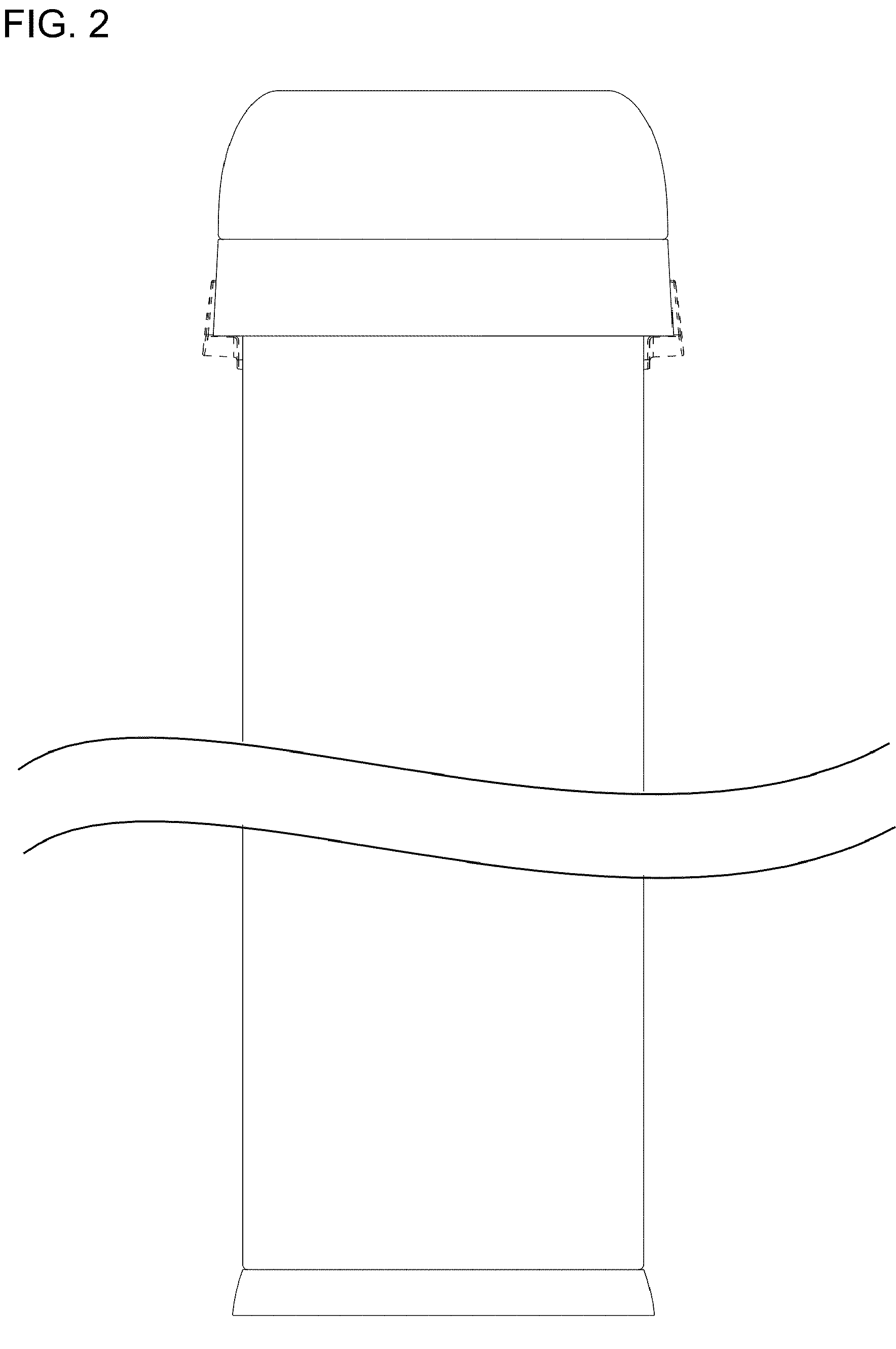


The patentee simplehuman took the position that the various lines in question were contour lines; the accused infringer said they were “seams”, i.e., ornamental features that would need to be taken into account in determining infringement. The court created an annotated version of Figure 1 to “point out the disputed lines” of the ‘087 claimed trash can:

I’m guessing here (ha), but I’ll bet that the defendant’s product is devoid of such lines! To any design patent practitioner the lines in question are so clearly contour lines as to be beyond debate. They are commonly referred to as CAD lines or wire frame lines. Such lines do not generally comply with the USPTO’s drafting rules (time to update those?). Nevertheless, the USPTO routinely accepts drawings with such lines, because everyone knows that they represent contour and cannot possibly be ornamental features. The patentee nevertheless made a mistake in not having its draftsman either remove those lines entirely and/or replace them with standard shading before filing.
Another (practical) reason to remove those lines is that the resulting claimed design will look more like an actual product, rather than a confusing mess. A properly drawn product will be more easily compared to an accused design, especially by a jury.
The court said that the dispute in this case is resolved by the specification, saying “The illustrations in the design patents show the disputed lines in views where they cannot possibly represent shading.” This is the court’s logic:
1. The disputed lines occur on the right side of the trash can (see Fig. 1).
2. The top view of the trash can (Fig. 4) suggests an oval shape where the right side is largely flat.
3. Fig. 2, the front view, confirms the general flatness of the right side.
4. But Fig. 3, the right side, includes the disputed lines around the center.
The court is correct about all four of its observations (but for the “But”). How does that logic result in the disputed lines being called lines and not contour lines? Beats me.
Again, any experienced design patent practitioner knows that those lines represent areas where the underlying surface changes from straight to rounded. Standard stuff.
The court actually admitted that:
“At most, the disputed lines thus represent a delineation between rounded and flat surfaces.”
The court then discounted what it just said: “[T]hat does not suffice to show contour because it does not indicate which surface is receding (because it is curved) and includes lines in views where there would be no contour differences (the top down views).”
Interpretations to the previous quote welcome; feel free to post a comment to this blog.
Bottom line? Take out those damn CAD/wire frame lines before filing. And if there’s any doubt about the shape of the resulting design, have your draftsman insert some standard surface shading.
Simple, humans, right?
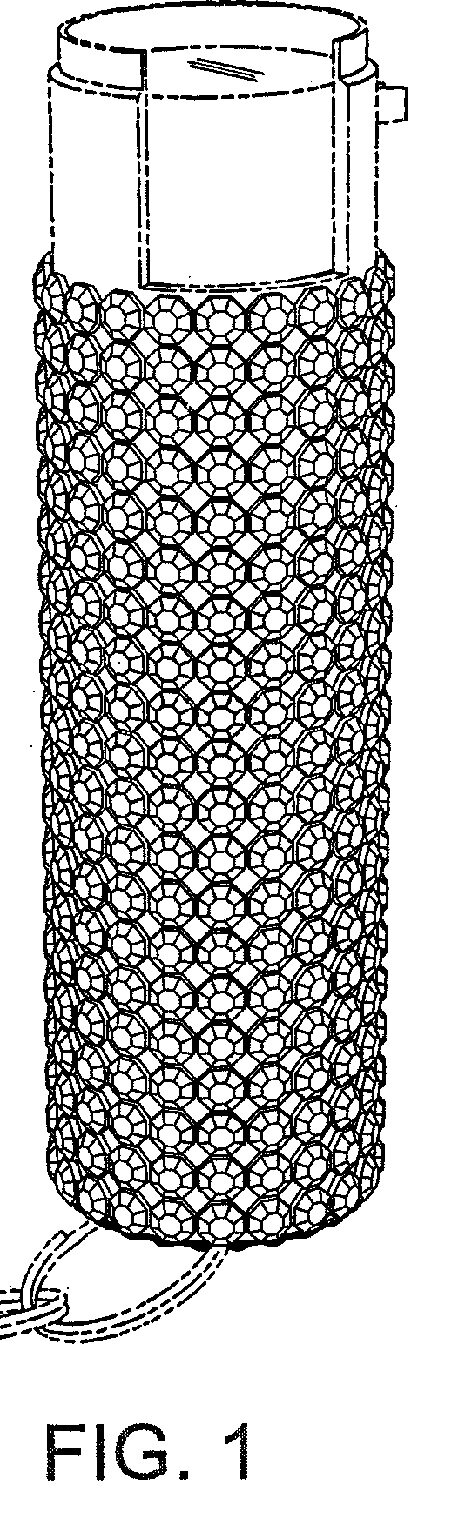
The U.S. Court of Appeals for the Federal Circuit on December 11, 2020 handed down Super-Sparkly Safety Stuff, LLC, v. Skyline USA, Inc. (Case No. 2020-1490). In a non-precedential opinion, the Court reviewed de novo the lower court’s decision granting summary judgment of non-infringement. The Court found no infringement under the ordinary observer test in that the patented and accused designs were “plainly dissimilar” and “sufficiently distinct”, which did not require consideration of the prior art. Even if not “sufficiently distinct”, the Court found that there was no infringement when taking into account the prior art as commanded by Egyptian Goddess. The design claimed in the asserted U.S. Pat. No. D731,172 was for a “Rhinestone Covered Container for Pepper Spray Canister”.
Below are illustrations of the perspective and bottom views of the ‘172 patent, the accused design, and the closest prior art “Pepperface”.
PATENTED DESIGN

PATENTED DESIGN - BOTTOM VIEW

ACCUSED DESIGN

PEPPERFACE PRIOR ART
The parties had agreed that the difference between the patented and accused designs was that the former claimed the rhinestones on the bottom of the canister, whereas the latter did not. The Court found that removing the rhinestones from the bottom surface was a “significant departure” from the claimed design, resulting in sufficiently distinct designs even when not considering the prior art.
Then the Court admitted that there were not many examples of prior art designs, but nevertheless the prior art Pepperface reference had rhinestones “around the majority of the canister”, but not on the bottom. Citing Egyptian Goddess v. Swisa, the Court then said:
“[The] attention of a hypothetical ordinary observer conversant with bedazzled pepper spray canisters would be drawn to the presence or absence of rhinestones on the bottom of the cylinder.”
This is reminiscent of the old “point of novelty” test that was abolished by Egyptian Goddess. That is, the Court essentially said that having rhinestones on the bottom was the point of novelty that distinguished the patented design from the prior art, and since the accused design did not have that point of novelty, there was no infringement. It did appear that rhinestones on the bottom was indeed novel, since it was not found in the Pepperface prior art, nor the closest prior art of record, U.S. Pat. No. D667,999. So, are we now reverting to the old Litton “point of novelty” test?
Another significant point is this. This case was decided on summary judgment, i.e., the court concluded that there were no material facts in dispute, meaning no reasonable jury could find in the non-movant’s (i.e., the patentee’s) favor. But is that true?
I have previously ranted and raved about the unfairness of a “sufficiently distinct” finding that allows a court to ignore the prior art. For one thing there’s no objective way for a court to determine whether two designs are sufficiently distinct, and for another, there’s always prior art that’s relevant to the infringement analysis. A court finding that a patented design is “sufficiently distinct” from an accused design effectively steals the patentee’s right to a trial by jury on the ultimate issue of infringement. Whether the prior art is closer to the claimed design or accused design is a question of fact, ideally suited for a jury. A holding by a court on summary judgment that the two designs are “sufficiently distinct” prevents this question from ever coming before the jury.
Moreover, in this case, it’s not so clear that the patented and accused designs were not substantially the same in overall appearance. In the ‘172 patent, the rhinestones cover the canister all the way to the bottom edge, as they do in the accused product. However, in the Pepperface prior art, the rhinestones only cover a portion of the outer cylindrical surface of the canister; the rhinestones are centered on the cylinder, leaving exposed portions of the cylinder both at the top and bottom. Surely, in light of the fact that the rhinestones in both designs extended all the way down to the bottom, a jury could find that the patented and accused designs are closer to each other in overall appearance that either is to the Pepperface prior art, in spite of the differences on the bottom of the canisters.
Indeed, what is the difference between the bottom not having rhinestones and a portion of the cylindrical surface of the canister not having rhinestones? Either way, rhinestones are missing.
The court did not mention the prosecution history of the ‘172 patent. It reveals that the examiner found that the application disclosed 4 embodiments (Figs. 1-5, 6-8, 9-11, and 12-14). Each of these embodiments claimed a different length of rhinestones on the outer surface of the cylindrical canister. The examiner concluded that the 4 embodiments were patentably indistinct, i.e., basically the same, commenting that “the differences between the appearances of the embodiments “are considered minor”. Clearly, if the 4 embodiments are basically the same, even if they have a different length of rhinestones on the exterior, an argument could have been made that they are basically the same as the accused design. The absence of rhinestones on the bottom - had it been claimed - would very likely have been considered by the examiner to be basically the same as embodiments that had rhinestones on the bottom. Since “basically the same” is virtually indistinguishable from the “substantially the same” test for infringement, the prosecution history made out a plausible argument for a finding that the defendant’s design infringed the ‘172 patent.
It could also be argued that the ordinary observer, giving such attention as a purchaser usually gives (as required by Gorham and Egyptian) would pay scant attention to the bottom of the canister rather than the exterior cylindrical surface. After all, it’s the exterior surface that gets advertised, noticed at the point of sale, and held by the user (note that of the 6 illustrations in the Pepperface ad, none showed the bottom of the canister). It could easily have been found by a jury that the exterior cylindrical surface is the dominant visual component noticed by an ordinary observer “giving such attention as a purchaser usually gives”, who may not even notice whether the bottom is covered with rhinestones.
In reviewing past case law, little attention has been paid to the Gorham and Egyptian requirement to consider what a purchaser would do, in contrast to the clear wording of the test for infringement:
“[I]f, in the eye of an ordinary observer, giving such attention as a purchaser usually gives, two designs are substantially the same, if the resemblance is such as to deceive such an observer, inducing him to purchase one supposing it to be the other, the first one patented is infringed by the other.” (emphasis added)
Thus, in analyzing infringement there should be an inquiry into what attention a purchaser usually gives when buying a product. For example, when buying a refrigerator or TV, does the purchaser pay attention to the bottom, sides or back of the product? Even if those elements may be claimed, they are generally not dominant features viewed by a purchaser who would likely focus on the front of the product. Does a purchaser pay attention to the visual appearance of the insoles of Crocs shoes (see Int’l Seaway)? Does a purchaser pay attention to the visual appearance of the bottom of a shrimp container (see Contessa)? Would a purchaser pay attention to the top of a ceiling fan (see Fanimation)? These are legitimate inquires under both Gorham and Egyptian, yet the cases are silent about this requirement.
It is curious that the accused infringer was represented by Robert Oake, the same attorney who represented Egyptian Goddess back in 2008. This time, Mr. Oake was arguing non-infringement, while in Egyptian he was arguing infringement. While Egyptian was very significant regarding the issues of design patent claim construction and the abolishment of the point of novelty test, the patentee nevertheless lost on the merits. Its patented nail buffers, having pads on 3 of the 4 sides of an elongated, square, hollow body, was found not to be infringed by a nail buffer having exactly the same elongated, square, hollow body but with 4 pads, one on each side, instead of 3 as in the claimed design. The patented and accused designs in Egyptian, and the closest prior art, are shown below:

EGYPTIAN GODDESS
Note the following: the patented and accused designs are both elongated rectangular, hollow squares having pads on their sides; no prior art reference taught that appearance. The Falley reference was solid with no pads. The Nailco reference was elongated and hollow, but triangular. Even though Nailco has pads on all 3 sides, any ordinary observer would see that the patented and accused designs are closer to each other than to the Nailco prior art. Whether one of four pads was missing or not is relatively minor, and is probably not visually important to an ordinary purchaser. Three vs. four pads may be important functionally, but visually the two designs could easily be found substantially the same in overall appearance. What did the Federal Circuit say in Egyptian?
“[U]nlike the point of novelty test, the ordinary observer test does not present the risk of assigning exaggerated importance to small differences between the claimed and accused designs relating to an insignificant feature.”
Yet, in the present case, the Court did exactly that: assigned exaggerated importance to a minor difference – the presence or absence of rhinestones on the bottom of the canister, that an ordinary purchaser would likely pay little or no attention to.
The facts in Super-Sparkly are fascinatingly similar to those in Egyptian, and both cases involved Mr. Oake as counsel. And in both cases the lower court granted summary judgment motions of non-infringement. In Egyptian, one side of a design had something missing (the patented design was missing a pad), and in Super-Sparkly, one side of a design had something missing (the accused design was missing rhinestones). Maybe Mr. Oake learned from Egyptian that siding with the missing side was the side to be on!
Perry Saidman is available to present private seminars on design patents to your in-house group of lawyers and/or designers, either in person or virtually. As a former professor teaching Design Law at the George Washington University Law School, and as a preeminent figure in the design patent bar, your group can greatly benefit from Perry’s experience and expertise. His c.v. is here.
In a half or full day session, Perry can cover key design patent topics like obviousness, anticipation, functionality, infringement, damages, double patenting, including recent case law. He can also cover design copyrights and/or trade dress protection.
As an option, Perry can provide strategic feedback and advice about your specific cases, either issued, pending, or planned in the future. The seminar can be tailor-made to your individual wants and needs.
For further information, contact Perry at ps@perrysaidman.com
Further to my post of August 15, I’m attaching the slideshow I presented at the IPO Annual Meeting last month which suggests amendments to the design patent laws, to bring them into the 21st century.
The design patent laws have never been amended; the current version was adopted with the 1952 patent act. Clearly, it’s time for an update.
A subcommittee of the IPO Industrial Design Committee has been formed to consider possible legislative updates to deal with various issues that have arisen in the caselaw, long overdue.
Comments are welcome.
This is a bit different from my usual design law posts (actually, a lot different), to introduce you to an organization I have belonged to for many years – the Project for Integrating Spirituality, Law & Politics (PISLAP).
News and social media sources have been filled recently with news of the passing of US Supreme Court Justice Ruth Bader Ginsburg. Often it is only after someone dies that their true legacy is appreciated. Maybe with the passing of this remarkable lawyer, aspirations to transform and reimagine the profession are being ignited. This quote of RBG’s stands out: “I tell law students… if you are going to be a lawyer and just practice your profession, you have a skill—very much like a plumber. But if you want to be a true professional, you will do something outside yourself… something that makes life a little better for people less fortunate than you.”
In a nutshell, that is what PISLAP is all about.
A new edition of The Conscious Lawyer, published by Elaine Quinn in London, and produced in collaboration with PISLAP and co-edited by PISLAP co-founder Peter Gabel, has just come out. The issue contains a wonderful diversity of subjects, from Ross Brockway's excellent article about the Georgia Justice Project's visionary representation of a client trapped in the maze of punitive child support laws, to Femke Widjekop's hopeful description from Holland of the new and healing "green criminology," to Jenipher Jones's discussion of the consciousness-elevation of Contemplative Lawyering, to Elaine's thoughtful review of Rhonda Magee's recent book The Inner Work of Racial Justice….all PISLAP members!
Please do read the issue, share it with friends, and consider joining PISLAP as a member and become part of a group whose influence and membership is expanding towards building a new and more humane and caring legal system.
This case is significant only because the USPTO cannot seem to print the drawings in issued design patents with a sufficient degree of clarity. For many design patents, there is a huge degradation in image quality between the drawings originally filed by an applicant and those that are printed in the issued patent. This has been a longstanding problem.
Originally filed high-resolution drawings are routinely stored in a USPTO database called the Supplemental Complex Repository for Examiners, or SCORE. Design patent Examiners use the SCORE drawings to examine the application. Once the patent is allowed and printed, many of the high resolution SCORE drawings have undergone a presumably unintended metamorphosis into unintelligible, highly pixilated drawings, where it is frequently impossible to distinguish between a broken line and a solid line; this is important, obviously, because solid lines define the claimed design, and broken lines define unclaimed subject matter. For design patent applications filed with high quality photographic images, the images in the printed patents frequently are out of focus, out of contrast, and simply look awful. Many examples abound.
Woe is the patent litigator who must assert one of these terribly printed design patents in court. How is the judge supposed to determine the meaning and scope of a design patent claim that on its face, i.e., on the face of the printed patent, have drawings that are unintelligible and thus arguably indefinite?
One court has offered a path out of this mess. In Panasonic Corp. v. Getac Technology Corp. et al., the district court for the Central District of California considered whether to incorporate the SCORE drawings of the 4 design patents at issue into its claim construction.
In the illustrations below, on top is FIG. 19 of the original SCORE drawings of Panasonic’s U.S. Pat. No. D766,232, while on the bottom is the same figure as printed in the ‘232 patent. The problem is manifest.

The defendants contended that the patents were indefinite because of the lack of clarity in the printed patent drawings. The patentee Panasonic responded by asking the court to rely on the SCORE images to determine the scope of the patents in issue.
The Defendants argued that the court could not substitute file history drawings for patent figures, and cannot correct any errors in a patent that are not evident on the face of the patent. More particularly, the Defendants argued that an ordinary observer of a design patent would not have understood that the SCORE drawings (and not the figures on the issued patent) defined the scope of the claim because there was no mention of other drawings in the patent specification. Defendants also argued that Panasonic chose not to correct its patents using a Certificate of Correction, choosing instead to sue the Defendants on patents “they knew were defective”.
There is no dispute, the court said, that the SCORE drawings are part of the prosecution histories, and that the Patent Act requires “a patent’s claims, viewed in light of the specification and prosecution history” to “inform those skilled in the art about the scope of the invention with reasonable certainty”, citing the 2014 Supreme Court decision of Nautilus, Inc. v. Biosig Instruments, Inc.
Interestingly, the court cited the test from In re Maatita which said that a design patent is invalid for indefiniteness under Sec. 112 “if one skilled in the art, viewing the design as would an ordinary observer, would not understand the scope of the design with reasonable certainty based on the claim and the visual disclosure”. The court also relied on the Federal Circuit decision Phillips v. AWH Corp. that said claim construction is provided in view of “the claims themselves, the remainder of the specification, [and] the prosecution history.”
The district court had no trouble in construing the claim of the ‘232 patent as follows:
“The ornamental design for a portable computer, as shown and described in Figures 1-20 of the patent and Figures 1-20 located in the D’232 Patent file history and available through the Supplemental Complex Repository for Examiners (“SCORE”) database. The broken lines shown in the figures represent environment only and form no part of the claimed design.”
It made similar constructions for the other 3 patents in suit.
Score one for the patentee!
I will be speaking on The Future of Design Patent Law at the Intellectual Property Owners (IPO) Annual Meeting, which takes place online September 21-24, 2020. The exact day and time of my talk has not been finalized.
Statutory changes in the design patent laws (35 U.S.C. 171 et seq.) are long overdue. In fact, despite numerous statutory amendments to the general patent laws (35 U.S.C. 101 et seq.) there has been no change in the design patent laws in nearly 70 years, since the passage of the 1952 Patent Act. Such changes can address numerous gaps and deficiencies in the design patent laws, and update other sections of 35 U.S.C. (which were written for utility patents) to make it clear that design patents are governed under a separate legal regimen (as one example, the requirement in 35 U.S.C. 112 that a patent disclosure must teach one how to “make and use” a claimed invention makes no sense when it comes to aesthetic designs).
I will “introduce” legislation to address these gaps, deficiencies and inconsistencies, as well as improve the system for the benefit of users and the public. The proposed new laws will also correct some poor judicial decisions that have wreaked havoc both in design patent prosecution and enforcement.
More particularly, my talk, and the legislation, will address such issues as:
*protecting the design, rather than the article of manufacture to which it is applied (as is done in Europe)
*defining “ornamental”
*defining “functionality”
*introducing a new Sec. 112 for designs
*providing for multiple claims in a design patent
*clarifying permissible amendments to the drawings
*defining design patent anticipation under 35 U.S.C. 102 to effectively overturn International Seaway
*requiring consideration of the prior art in determining infringement
*updating 35 U.S.C. 289 re: total profit damages
*addressing miscellaneous issues such as inventorship, the manner of executing and amending drawings, the presence of logos/brands on the infringing product, and willful infringement.
It is believed that the virtual, online conference will draw from a large national and international audience, since travel expenses obviously need not be incurred. Don’t miss it.
The full program is here.
Several readers pointed out to me that the links to the two IPRs cited in yesterday’s post were inoperative. I know how excited you are to review those opinions (right?), so I’m correcting those links below:
I apologize for stuffing your in-box again, but at least one of these opinions are well-worth reading (they are substantially the same), especially if you’re a design patent law aficionado.
Perry Saidman
